


When talking about menstruation, society tends to view it just from a biomedical lens that divides bodies into male and female binary.
In this Trans Awareness Month, we collaborated with APTN and Hinghoynoy to challenge this one-dimensional view of menstruation cycle.
Once Celebrated, Now Whispered
When challenging conservative lens that conflats multidimensional subjects and shames natural processes, traditions tend to be blamed. Hinghoynoy and partner with their goal in liberating postcolonial ways of learning would like to challenge this notion.
Barbara Watson Andaya’s published study on the history of Southeast Asian women, The Flaming Womb : Repositioning Women in Early Modern Southeast Asia, revealed that menstruation was once celebrated by families across Asia and Pacific communities as a sign of safely growing into adulthood. This is in stark contrast with current societies that see menstruation as a sign of AFAB body: sexual, shameful, unsuited for public eyes. The cycle of menstruation was seen as a marked entry into a space to learn about bodily change and about the cultural knowledge tied to the cycle. It was not seen as a single experience, and it is indeed not.
And the entity twisting this, calling it barbaric, was once again the colonial powers.
Dimensions Behind Codes
In the current world where menstruation is shamed and hidden, menstruating individuals have started using coded words to refer to it.. While many conversations have been had to avoid using coded words to fight the stigma, it is also interesting to see that these coded words reflect the diverse experiences of menstruation cycles as they carry social, political, and economic context.
Societies with coded words that allude to the cycle’s closeness to the moon cycle, such as Indonesia (datang bulan) imply their reverence to Lunar calendar. Chinese language with many coded words that is adjacent to family relatives (大姨妈, 親戚, 姨妈) carry social and cultural context surrounding familial guests. There are even coded words with historical context, such as Philippines’ regla that was rooted from the colonial power’s language and Japan’s ペリー来航 that referenced a historical moment that caused a disturbance.
These coded words remind us that the cycle of menstruation is never a single experience. None of us lives a single issue life, nor any of us is one-dimensional. Why wouldn’t we assume the same for our cycle?
And when society conflats cycle of menstruation into a single gendered dimension, who gets left behind in the conversations?
“For 25 days, I live freely as a man.”
Those words were said by Anu Shahi in Unity for Change’s Silent Flow: A Documentary on Trans Menstruation. In the documentary, he shared that the gendered view of menstruation made it hard for him to not only join in normal activities during his cycle, but also to get information about his health. “Doctors’ questions and glances feel suffocating,” he said, “That’s why I still haven’t fully embraced menstruation.” Nishant Shah in the same documentary echoed the statement. The society’s stigma has forced him to hide his identity as a trans man. “While my friends move freely, I sneak to the toilet,” he shared.
In Menstruation Handbook for Trans and Gender Diverse People in Asia Pacific, APTN pointed out that the gendered stigma of menstruation limits trans men and gender diverse individuals’ abilities to experience their cycle with dignity and even forces them to dress in a way that causes gender incongruence (dysphoria). Lack of access to knowledge and materials for them to use the right combination of menstrual products and underwears have forced them to choose either experience gender incongruence, isolate themselves from the world, or avoid bathrooms and risk health issues such as UTI and even TSS (Toxic Shock Syndrome). And when public bathrooms only provide menstruation-support facilities in women’s stalls, they now have to choose between hiding their disposed pads in male facilities or going to the women’s stalls while looking masculine – both carry real danger of being outed and assaulted.
Menstruation Beyond Genders
APTN and Hinghoynoy have shared insightful lived experiences that invite us to look at the cycle of menstruation as a part of our multidimensional lives. Let us reclaim the multi dimensions of menstruation cycles from our own history and lived experiences and liberate ourselves from the colonialist binary views in Asia Feminist LBQ Conference 2027 with:
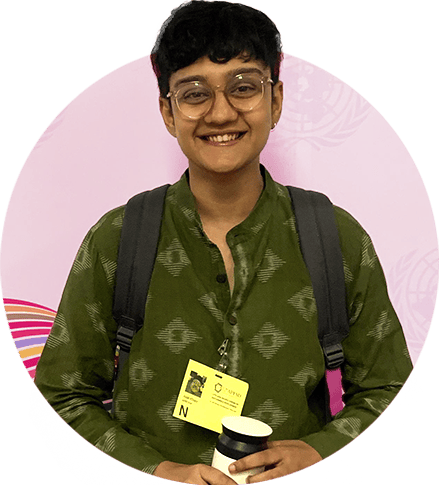
Avali Khare from APTN | Changing Seeds | It’s T Time | Unity for Change
In this discussion panel, Avali will moderate the discussion and sharing about menstruation experiences and advocacy in India, Nepal, Sri-Lanka, Vietnam, and Thailand.
Want to deepen your understanding before joining the discussion? Check out these publications from APTN and their partners!
- Menstruation Handbook for Trans and Gender Diverse People in Asia Pacific by APTN
If you have been avoiding to go to check-ups out of fear of having your gender incongruence and traumas ignored, this sort and sweet booklet is for you. This booklet is a quick guide for menstrual products, needs, tips on how to experience your cycle with dignity while going out, and how to prioritize for your physical safety while also caring for your mental health. - Right to Heal by Changing Seeds
How does a post-surgery hygiene checklist look, and who needs health information about menstrual products? This SRHR booklet for post gender-affirming surgery answers them, and many others. - Silent Flow: A Documentary on Trans Menstruation by Unity for Change
Want a sneak peak on the lived experiences of trans menstruation? Watch this documentary that covers the interviews with Anu Shahi and Nishant Sah about their trans identities and menstruation experiences.

Na from PB | Ruang & Beaut from Hinghoynoy
In this session, we are invited to find the meaning of the menstruation cycle from our lived experiences through creative mediums.
Curious on who will guide your exploration into your own understanding of the menstruation cycle? Here’s some information for you to look forward to!
- PB
PB is a community library that exercise experimental methods to decolonize learning about literature and knowledge. - Hinghoynoy
Hinghoynoy is a community space that believes that children too deserve to have a space to exist and talk in the community. In their social media, Hinghoynoy opens conversations touching issues societies see as sensitive in children-friendly ways.