


How do you organize a community spread across various regions with no clear model yet? In this Trans Awareness Month, TransEqual shared how they started organizing toms and transmasculine communities across four regions in Thailand in the times where very few trans men-led organizations.
And it started by demolishing the walls of masculinity norms.
Dimensions of Organizing
Over the past nearly three years, TransEqual has worked to build and expand their community through three interconnected dimensions of organizing:
- Ideological Organizing, where they create storytelling space for members to share their lived experiences and listen to each other.
- Action Organizing, where they bring community members together to take action on issues that directly affect their lives and gradually grow into leadership roles in their own ways.
- Political Organizing, where they create opportunities for community members to move beyond being people who are affected by policies to becoming people who actively shape them.
The dimension they had to prioritize in their first years was ideological organizing. The first roadblock TransEqual found in starting the movement was that many people in the transmasculine community are more accustomed to dealing with challenges on their own than coming together to build collective power. This may be partly connected to dominant norms of masculinity, which teach men to be strong, self-reliant, emotionally reserved, and capable of handling problems without asking for help. These expectations make it difficult to bring people together.
TransEqual also believes that organizing means creating a culture where nobody is the sole leader and teacher; especially when organizing across various regions with different experiences and needs. So instead of dictating how they should think about masculinity, TransEqual starts their workshops with one simple question:
“Who gets to decide what masculinity should look like?”
This question always opens up interesting conversations. When toms and transmasculine individuals are given a storytelling space, they soon discover that masculinity is far more diverse than the images and expectations they commonly see in society.
The participants come from diverse backgrounds in terms of age, occupation, socioeconomic status, education, religion, and lived experiences. Some identify as toms, some as transgender men, others as transmasculine or nonbinary. Some prefer not to label their gender identity at all, while others simply identify themselves as men.
Some of them enjoy painting their nails or playing with dolls. Some are attracted to men, and others who could have romantic or sexual relationships with people of any gender. Some carry the expectation that they have to be the breadwinner of their families, while others want to build families and experience pregnancy themselves.
These experiences encourage them to question the assumptions that masculinity means looking like certain bodies, being attracted to certain genders, behaving in particular ways, or taking on specific roles within their families. Redefining masculinity does not mean rejecting or destroying masculinity, nor does it mean devaluing femininity. Rather, it is about expanding the possibilities of what masculinity can be, allowing different expressions and experiences of masculinity to exist without being judged against a single standard.
No Definitives in Movement-Building
TransEqual further notes that a part of organising is the constant learning and unlearning; that there is no ready-made answer in movement-building. Let us take part in LBQ movement building by taking lessons from their experiences and sharing our own to liberate ourselves in Asia Feminist LBQ Conference 2027 with:
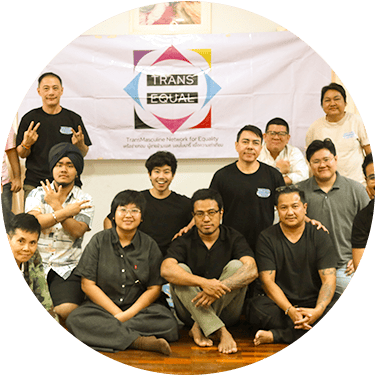
TransEqual
In this panel, TransEqual invites participants to reflect on what it takes to build sustainable collective power through stories from community leaders, grassroots organizers, and academic-community collaboration across various regions of Thailand.
Want a sneak peek on how toms and transmasculine lives look through the lens of various background contexts? Check out Just Be Me, a book containing stories of 11 toms and transmasculine individuals from various age, background, community context, culture, beliefs, language, and location.
Buying this book also means you can directly support TransEqual’s work in organizing toms and transmasculine communities in Thailand!